Hiring an AI engineer instead of a freelancer
Updated August 2026
Four things decide this, and price is the least interesting of them. Here is where each option actually wins — including the jobs where hiring a person is not merely better but the only defensible answer.
1. What the work costs
A competent freelance developer bills somewhere between a few hundred and a few thousand for a small piece of work, depending on where they are and how specialised it is. That number buys judgement as well as typing, which is the part people forget when they compare it to a system that automates parts of the work.
An AI coworker changes the cost shape without removing third-party bills: Agentic Cloud Computer is free to use, but your company pays its AI and cloud providers directly. The useful difference is that a team can hand over many small, well-scoped jobs without finding and briefing a new person for each one.
Where that flips: a job with real consequences. Anything where being wrong could cost a customer, money or a legal obligation is not the place to economise on judgement.
2. How fast it starts
Finding, briefing and trusting a freelancer takes days at best. Their first week is partly spent learning your setup, which you pay for and which is entirely reasonable.
An agent starts in minutes and has no calendar. That advantage is largest for the things that are urgent and small — the broken form on a Sunday, the price that is wrong during a promotion — and smallest for the things that were always going to take a fortnight of thinking.
Being available at 2am is not the same as being right at 2am. Speed is a real advantage; treat it as one advantage rather than as the answer.
3. Who holds the context next month
This one is underrated and it decides more projects than price does. A freelancer who built your thing in March remembers in June why the weird bit is weird — if they are still available, which is the catch: they have other clients, and the good ones get busy.
An agent with a persistent machine keeps the work, the notes and the history in one place, and it is available in June by definition. What it does not have is the unwritten context — the reason you do it this way, the customer who complained, the thing you would never do again. That lives in your head, and you have to say it out loud, every time it is relevant.
The practical middle ground most people land on: the agent holds the code and the routine work; you keep a short written record of the decisions and why. That document is worth more than either of them.
4. Who you can hold responsible
Here the freelancer wins outright, and it is not close. A person can be accountable for an outcome, can say “that approach will not work and here is why”, and can carry professional liability. An agent can do none of those things. It will build the bad idea you asked for, well.
So keep a human in the loop wherever a mistake reaches customers, money or the law — which in practice means someone looks before a change goes live. Any agent worth using makes that step structural rather than optional; ours will not land a change to your code until you tap approve, and cannot spend your money at all.
Where each one clearly wins
Give it to an agent when the job is small, well-defined and repeatable; when it is urgent and low risk; when there are twenty of them and each one is individually not worth an invoice; or when you want to find out whether the idea is worth paying a professional for.
Hire a person when the design is the hard part; when the work is regulated, safety-critical or legally binding; when it needs someone to sit with your team and argue; or when you need somebody to be answerable if it goes wrong.
Do both — the arrangement that works best in practice. The professional decides the shape and reviews what lands; the agent does the volume in between. That is roughly how a senior engineer works with a junior one, and it is a well-tested division of labour.
If you are not technical at all
Then the honest advice is to start with something small enough that you can judge the result yourself. You cannot review code, but you can absolutely check whether the booking page books. What to hand an AI engineer in the first week is written for exactly that reader, and the small business page lists five jobs that reliably land.
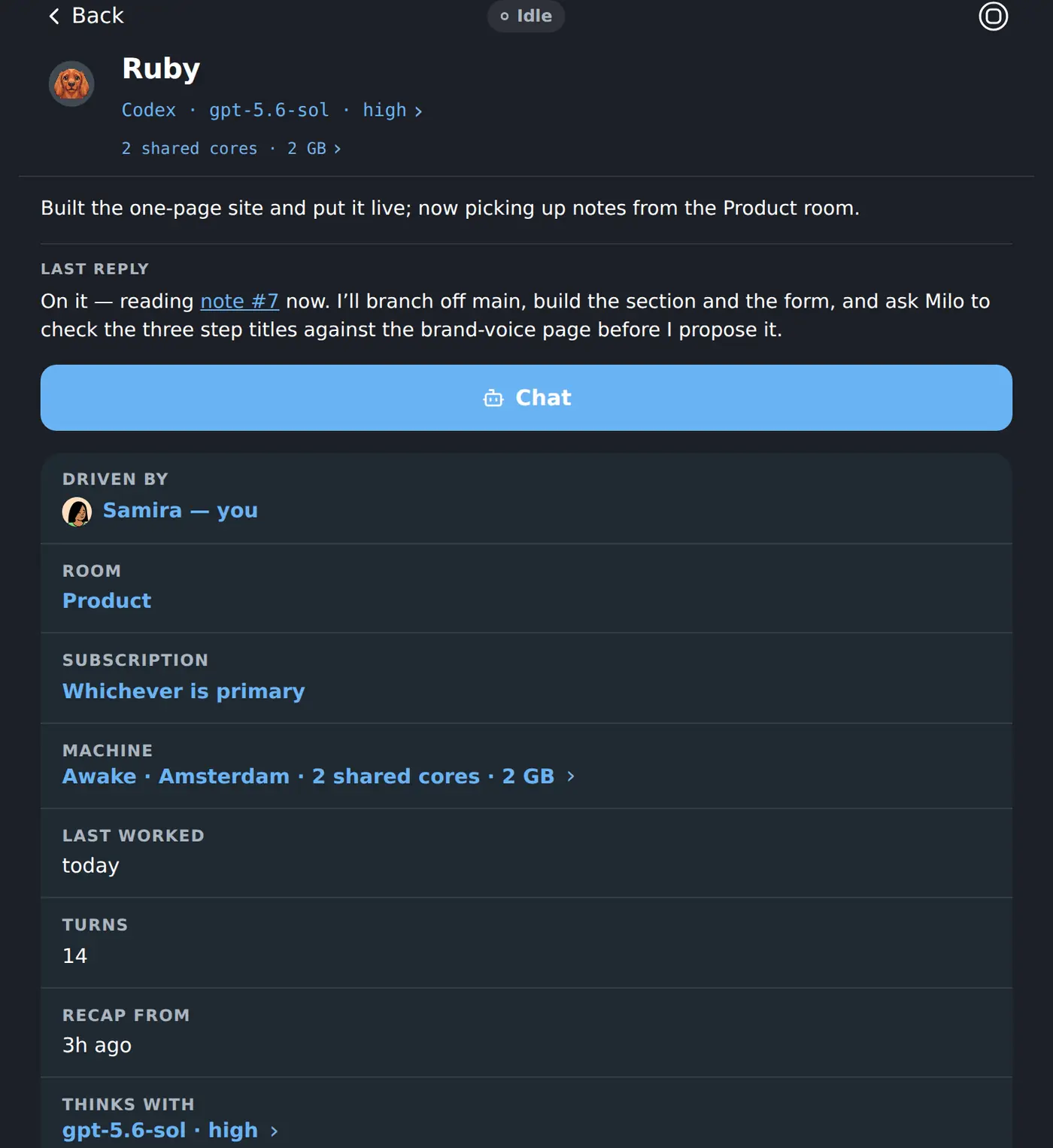
The cheap way to find out which of the two you need: give the small job to an agent this week. What we run is that at company scale — persistent coworkers on cloud computers, managed from one shared Workspace and using the AI access your company chooses. If the work that comes back needs a professional, you will know precisely what to brief them on, which is worth the week on its own.
Keep reading
- Running Claude Code in the cloudFour ways to move Claude Code off your laptop — leaving the machine on, a VPS, managed hosting, or an agent that owns its computer — and what each one really costs.
- What to hand an AI engineer in the first weekFor the non-technical reader: five jobs that land, how to phrase a request so it comes back right, what goes wrong in week one, and what an agent genuinely cannot do.
- An AI engineer for a small businessThe website, the spreadsheet nobody wants to update, the orders that arrive by email: what an agent can genuinely take off a small business, and what it costs to try.